
di Marco Mazzarino – Department of Architecture and Arts, University Iuav of Venice,, Italy – CFLI (Centro di Formazione Logistica Intermodale), Venice
Abstract
The current state-of-the-art of the decision-making processes by operators in the Italy-Croatia region presents a significant mismatch between demand (from users) and supply in the rail industry within end-to-end multimodal transport chains. The main reason can be found in the dramatic lack and fragmentation, visibility and transparency of information when it comes to freight railway opportunities, which ultimately determine a very poor use of the rail transport mode. The aim of the paper is to develop a common cross-border tool – called “ScanRail” – providing relevant information about overall railway offering to operators in Italy and Croatia in a transparent, consolidated, standardized and integrated manner to support the decision-making processes of logistics and multimodal transport operators. As a result, instead of going through time-consuming, opaque and exhausting processes and procedures, operators get an overall cross-border railway offering by a “click”, thus, enhancing the attractiveness of rail transport in the region.
Keywords: railway transport, digital tools, Italy-Croatia region.
Short Bio
Marco Mazzarino is Professor of Transport Geography, Logistics and Supply Chain Management at the Università Iuav di Venezia. He co-founded Bestever Supplychain, a start-up and university spin-off dealing with innovation in transport, logistics and supply chain. He is Head of the SLU (Sustainable Logistics Unit) at Venice International University (VIU), where he oversees the development of international projects in the field of supply chain and logistics. He has participated in more than 70 innovation projects and has authored 90 publications, including 3 books. At Iuav, he has also served as Director of the Professional Master Program in ‘Global Supply Chain Management and Logistics’ for more than 15 years. He is a member of ALICE (Alliance for Logistics Innovation through Collaboration in Europe). He earned a PhD in Transport, Traffic and Environment at the University of Trieste in 1997, and further specialized at the Massachusetts Institute of Technology, the Institute for Transport Studies (University of Leeds), and the World Maritime University in Malmö.
- Introduction and goals: a freight train is not a shipping line, not even a bus – more an art
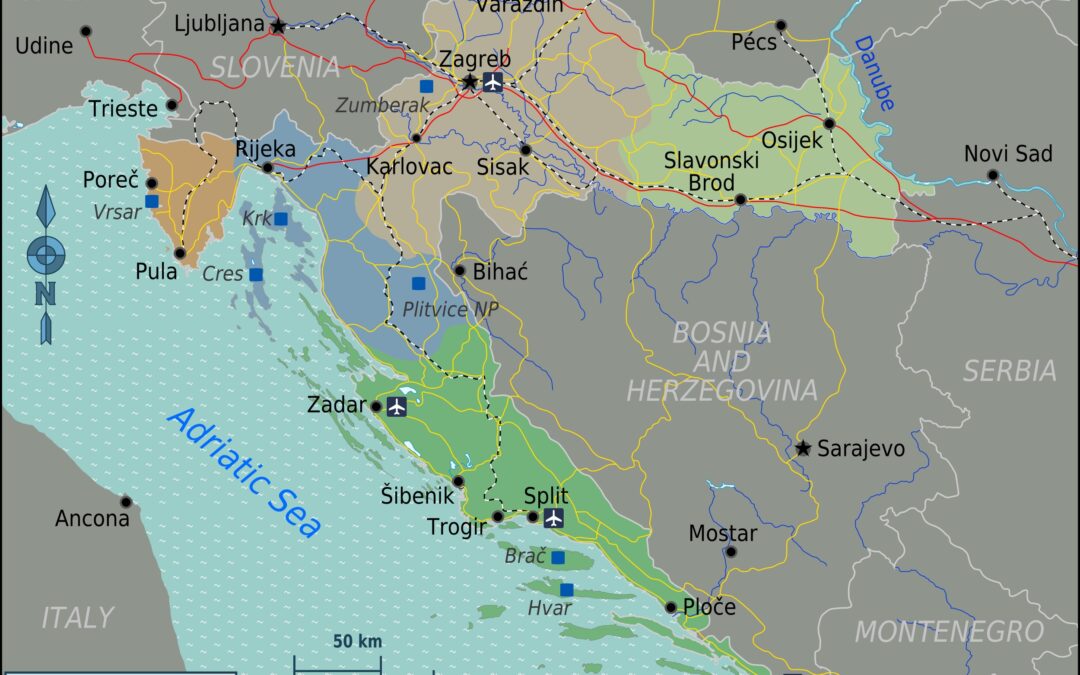
The current state-of-the-art of the decision-making processes by operators in the Italy-Croatia region (Fig. 1) presents a significant mismatch between demand (from users) and supply in the rail industry within end-to-end multimodal transport chains. The main reason can be found in the dramatic lack and fragmentation, visibility and transparency of information when it comes to freight railway opportunities, which ultimately determine a very poor use of the rail transport mode. Information for users is hardly accessible, missing and/or highly fragmented among – mostly, “national” – operators and various sources. Moreover, most of the information is private. As a result, a mismatch between demand (users) and supply is in place, causing a sub-optimization of multimodal transport decisions both from operational, socio-economic and environmental standpoints. When looking for opportunities of freight railway services and connections in the Italy-Croatia area, comprehensive information can only be found by contacting each railway company directly (calling on the phone or sending e-mails) – that is, in a highly fragmented and time-consuming way – and then negotiating each commercial term depending on the specific transport requirements. Moreover, information is provided usually in a non-standardized manner among different sources. Such characteristics reflect the peculiarity of the railway business with respect to other transport modes. Basically, in the rail industry “public” and “consolidated” comprehensive information is scantly existing, let alone standard formats. In fact, there is no “public”/open sources data set to get comprehensive origin-destination information, in particular of international and cross-border kind.
The aim of the paper[1] is to develop and elaborate a common cross-border tool – called “ScanRail” – on the TRANSPONEXT Platform providing relevant information about overall railway offering to operators in Italy and Croatia in a transparent, consolidated, standardized (common format) and integrated manner. In short, the Railway Module elaborates an integrated (cross-border) and consolidated railway offering based on standard information to support the decision-making processes of logistics and multimodal transport operators. The added value is even more significant given that information about “international” services is hardly available in the railway business, especially in the freight sector. Most of the time, railway services are operated at national level, while information about international connections must be found by piecing together national sections by means of a LEGO-like approach. Importantly, instead of going through time-consuming, opaque and exhausting processes and procedures, operators will get an overall cross-border railway offering by a “click”. Thanks to “ScanRail” operators will be able to find useful, consistent, standardized and relevant information about freight railway opportunities on the TRANSPONEXT Platform to support their decision-making processes about multimodal transport solutions.
Fig. 1: the Project Area. Source: https://www.italy-croatia.eu/cooperation-area
- The Digitalization of Rail Transport: A literature review
The global rail industry is undergoing a paradigm shift from legacy mechanical systems to an integrated, data-driven ecosystem. This transition, termed Rail 4.0, leverages the Internet of Things (IoT), Big Data, Artificial Intelligence (AI), and the so-called “platform economy” to optimize both passenger mobility and freight logistics (Gerhátová et al, 2021; Frank et al, 2019) so as to promote mode shift towards rail (Islam et al, 2016). In particular, modern freight rail transport focuses on the following topics:
- Predictive maintenance & asset health: the shift from “find-and-fix” to Condition-Based Maintenance (CBM) is crucial. Utilizing IoT sensors and digital twins allows for real-time monitoring of rolling stock, significantly reducing life-cycle costs and preventing failures (Di Ruocco and Mazzarino, 2025; Karakose et al, 2020).
- Smart freight and logistics: in the rail freight sector, digitalization addresses the issue of cargo tracking. Smart wagons equipped with GPS and telematics provide real-time data on cargo condition (temperature, humidity, shock) and location, which is vital for high-value or perishable goods (Ghofrani et al., 2018).
- Signaling and capacity: the implementation of ERTMS Level 3 and Automatic Train Operation (ATO) enhances track capacity. For freight, this means shorter intervals between heavy trains, allowing rail to compete more effectively with road haulage by improving punctuality and energy efficiency (Knutsen et al, 2023; Dominguez et al, 2011)
- Integrated ecosystems: while passengers benefit from Mobility-as-a-Service (MaaS) (Mojano et al., 2023), freight relies on the integration of rail into global supply chains via digital platforms (Kurniadi, 2025). This “Synchromodality” allows for the dynamic switching of transport modes based on real-time availability and costs (Lidén & Joborn, 2017).
Despite these advancements, literature highlights significant hurdles. Cybersecurity remains a paramount concern; as freight manifests and signaling systems move to the cloud, the risk of industrial espionage or physical disruption increases (Soderi et al, 2023). Furthermore, interoperability across borders is still hindered by fragmented regulatory frameworks (Hansen & Pachl, 2022). Moreover, additional critical issues consist of shifting toward the ethical use of AI in autonomous freight yards and the reduction of the industry’s carbon footprint through digital optimization (Drewnowski et al, 2025).
Among the topics identified in the literature, this paper focuses on the development of an integrated ecosystem and digital optimization for the cross-border rail freight transport sector—specifically within the Italy-Croatia region— according to the broader concept of synchromodality. The objective, as previously outlined, is to develop a digital platform capable of optimizing freight rail transport utilization and fostering its integration into cross-border supply chains.
- Materials and methods
The digital tool (“ScanRail”) is developed and implemented based on:
– A common cross-border methodology.
– A common set of attributes of railway connections to ensure a standard format for relevant information is in place to the benefit of operators (users).
– A common template supporting data collection in Italy and Croatia.
The tool is then integrated into the TRANSPONEXT Platform. More broadly, since the railway module is made of a data set, tools elaborating collected data to display available railway opportunities supporting transport choices in different potential scenarios, it can be conceived as an overall DSS (Decision Support System).
2.1 The common methodology
The development of the digital tool stems from users’ business needs and requirements, which highlights the lack and fragmentation of available information about railway transport to support multimodal transport optimization, thus, leading to a mismatch between demand and supply in the industry.
A common methodological approach is designed for data collection both in Italy and Croatia consisting of:
– The definition of the data set and data requirements.
– Data collection activities and data analysis.
2.1.1 The data set and data requirements
Data set and requirements consist of:
– The definition of the set of the types of relevant cross-border railway connections (O-D pairs).
– The definition of a set of transport attributes of relevant railway connections.
– The type of data to be collected from correspondent data sources.
The types of railway connections
To highlight the role that freight railway transport plays within a multimodal transport solution between the two countries and identify the types of potential railway opportunities for operators, we first consider two macro categories of end-to-end multimodal transport solutions of potential interest for Italy-Croatia rail connections:
– Maritime-based multimodal transport solutions (that is, end-to-end solutions involving ports between the two countries).
– Land-based multimodal transport solutions (that is, end-to-end solutions involving freight villages and inland terminals only).
For each of these categories we employ some criteria to maximize the number of railway opportunities for operators.
As for maritime-based transport solutions, the aim is to identify relevant maritime multimodal transport connections involving railways services. With the aim of maximizing the number of existing railway opportunities available to the benefit of operators and elaborate an extended set of railway opportunities, we consider in turn two types of potential rail connections to/from relevant ports:
– Direct connections.
– Indirect connections.
Direct connections consist of existing railway services directly connecting relevant ports with inland terminals/freight villages. In the TRANSPONEXT project relevant ports on the Italian side consist of those of Ancona/Pescara and of Bari/Brindisi.
Indirect connections are identified when direct railway services to/from relevant ports are not in place. However, operators using such ports could find it useful to get information about railway services provided by freight villages at intermediate steps of the entire multimodal transport chain. In fact, relevant freight villages in the TRANSPONEXT Project on the Italian side are those of Padua and Verona.
As for land-based multimodal transport – again, with the aim of maximizing the number of existing railway opportunities – we first focus on potential first-level railway connections (e.g., those connecting both countries directly ) and then on second-level railway connections (e.g., those railway connections which could be internal to one country although part of an overall multimodal cross-border transport chain). In short, relevant railway connections are those provided, on the Italian side, by major freight villages such as Padua and Verona.
The set of transport attributes
For each of the identified connections, relevant transport attributes (e.g., relevant characteristics of the railway transport service) are identified, including:
– Origin.
– Destination.
– Departure time.
– Arrival time.
– Transit time.
– Distances.
– Weekly schedule (operating days – from Monday to Sunday).
– CO2 emissions.
– Transport rate.
Type of data
Once relevant types of railway connections and related attributes are identified, the next step is to collect data and information about railway services from available sources. Here, we identify two categories of data:
– Data that can be elaborated from the information systems of operators (including freight villages and ports) as well as by the Chambers of Commerce, since it is collected in rather standardized formats and can be publicly available (public data).
– Data and information that can be obtained only as “best guess”, that is, information that is private and not standardized, since it is considered sensitive information (private data).
Such a distinction is very important when dealing with the freight railway sector, where many of the variables and parameters of the overall architecture of a multimodal transport solution turn out to be subject to negotiation between the customer and the operator. In fact, they are not publicly available. For instance, rate quotations/costs represent a very complex and tricky issue. First, rail pricing policies derive from a complex architecture involving many different actors and operators within a multimodal transport chain in which railway plays a role. Usually, a comprehensive rate is elaborated by the MTO (Multimodal Transport Operator) for the entire transport chain. Secondly, rates involving rail segments are the result of several cost components, including railway transport rates (for the so-called traction processes), terminal rates (for various handling processes) and slot rates (for accessing the railway network) – importantly, each of them usually referring to different operators (railway companies, rail terminal operators, and rail infrastructure manager respectively). Also, a comprehensive rate is the result of a variety of transport demand conditions which are peculiar to the specific customer, including the quality of service (e.g., frequency) and transport volumes (for instance, a significant variety of rates exist on a given connection in case a company train rather than a seasonal one or a spot-train indeed is offered, let alone on-demand trains). In the paper we elaborate some estimates based on (parametric) pricing figures (which are supposed to include major relevant cost components).
2.1.2 Data collection and analysis
On the basis of the overall data set and data requirements, data collection activities are performed. Data is collected using a common template from relevant sources, including interviews and meetings with targeted railway operators (like railway companies, terminal operators, etc.) as well as the analysis of information from companies’ websites. Moreover, some secondary sources are deeply analyzed to get additional useful information and estimates feeding the database.
As anticipated, two major issues arise when collecting data in the freight railway industry which undermines overall accessibility to data:
– First, most of data is private (for instance, in mostly all the situations a “public timetable” of regular lines in the rail freight transport – let alone data on rates, transit-times and other transport attributes – is not in place).
– Second, available data is partial – in particular, public data is usually available at freight villages. However, such data shows rail freight traffic leaving/arriving at the node only. That is, no data on origins and destinations and corresponding transit-time is available at freight villages (which is something clearly representing a strong limitation for the decision-making process of a transport and logistics operator). In fact, the lack of data on origins and destinations clearly undermines the need for operators to compare different rail options.
We were able to collect available data in Italy mostly from (sort of) public sources (Chamers of Commerce-like) to be able to develop an effective tool supporting the decision-making process of transport operators. Eventually, we collect data to be able to elaborate a comprehensive picture of the rail offering in the cross-border region – to include a complete set of transport attributes – so as to allow operators to compare available options. A comprehensive database is elaborated, which is then integrated into the platform. As for the Italian side, some 150 railway services are identified, elaborated and included in the database. Unfortunately, no data is reported from Croatia railway lines.
- Results
Overall results can be summarized as follows:
– Some 55 direct maritime-based railway services are in place connecting relevant Italian ports – represented in the TRASNPONEXT Project – with inland terminals in Italy. That means that the ports involved in the TRANSPONEXT Project – located in Central-Southern Italy – are well connected by rail, thus, allowing operators to assess various transport choices when moving into the hinterlands. In particular, major railway axes performing rather high frequency rail services include:
- Bari with Piemonte (Turin, Novara), Lombardia (Busto Arsizio), Verona and Brennero, Bologna.
- Brindisi with Piemonte (Turin) and Verona/Brenner.
– Some 90 indirect maritime-based railway connections turn out to be available to operators. Major axes are represented by railway services connecting Verona and Padua with Brenner. Additional significant connections include:
- Foggia with Padua and Faenza.
- Faenza with Turin.
– Only one type of direct multimodal land-based railway service is identified connecting Italy with Eastern Europe, which originates from the freight village of Cervignano. Given the “national” nature of the railway business, no detailed data was made available for potential intermodal (that is, unitized cargoes) connections beyond the cross-border node of Villa Opicina (VOP) towards Croatia. Cross-border rail connections can be operated only by certified and authorized railway operators – otherwise one must get information by each respective national railway companies. We collected some information by means of interviews with major rail operators. Major Italy-Croatia railway connections cross VOP first towards Slovenia. In Slovenia, two major rail connections with Croatia are in place: the most important one is on the Ljubljana-Zagreb line (crossing the border at Dubova), while a less significant one is represented by the Ilirska Bistrica-Rijeka railway line. We understand that the railway service Cervignano-VOP is operated by Alpe Adria and Metrans and it connects Italy with Serbia (Pančevo, in particular). In this context, INRAIL represents a major rail operator connecting Italy with the Balkans, in that it is one of the few rail companies authorized to operate cross-border rail connections with Croatia. However, it operates almost exclusively conventional traffic (commodities – such as scrap iron, fabricated iron products, chemical products, cereals, timber, cars and RID goods – both gas and liquid) by connecting companies equipped with rail junctions. In fact, direct land-based transport connections between Italy and Croatia reflects the trading pattern. In particular, INRAIL operates significant traffic volumes of scrap iron and iron products from subsidiaries of steel industries located in Friuli-Venezia Giulia (ABS, for instance) which have relocated manufacturing activities in Eastern Europe. On average, INRAIL operates some 150 trains per week, including heavy trains services (that is, trains carrying more than 1,600 tons) (Fig. 2).
Fig. 2: the INRAIL rail network. Source: https://inrail.it/index.php/societa/servizi
In the main, Balkan countries – including Croatia – usually lack major intermodal terminals/freight villages capable of collecting critical mass of traffic to make rail transport economically viable. Among the few, we find small private terminals close to Zagreb, in Slavonski Brod and in Kukuljanovo (managed by Mansped – the latter operates almost exclusively traffic flows to/from the port of Rjieka) in Croatia, which are equipped with rail junctions (some other small terminals can be found in Tuzla in Bosnia-Herzegovina). Additional examples include terminals managed by private logistics operators, such as Ralu Logistika, which however currently lack of rail connections.
Overall, land-based rail services are scant because of the difficulties of getting critical masses. Also, short distances are not of help. Importantly, the current status of the rail infrastructure is very poor. As a result, rail services are hardly economically viable – today rail rates to/from the Balkans are definitely high. At the same time, road transport rates turn out to be very low, thus, unrivalled.
– No railway connections are reported from the Italian ports of the TRANSPONEXT Project in the Mid-Adriatic. Most of them either do not develop railway services or they perform short-distance on-demand conventional railway services.
To conclude, the overall picture shows that most of the direct maritime-based railway opportunities for operators on end-to-end multimodal Italy-Croatia transport connections come from Southern Italy ports, while direct land-based railway connections are basically very scant (mostly, due to the status and poor management of railway infrastructures). However, a good number of railway opportunities exist indirectly, the freight villages of Verona and Padua playing a major role mostly towards Northern Europe final destinations.
- Platform integration and conclusions
The ScanRail Module is eventually being integrated into the TRANSPONEXT platform [https://transpogood.eu/en-gb/index?url-language=en-GB]. We designed and developed the interface and take care of domain management, installation, maintenance, back-up and other IT issues.
Although getting information on rail freight transport is subject to many limitations – as we discussed previously – through the integration of the ScanRail tool into the platform the goal is that of equipping operators with more knowledge to allow them then address private issues (for instance, to negotiate rates or transit-times based on traffic volumes).
Some examples of platform output are shown below (Figg. 2-3).
Figg. 2-3: sample ScanRail output from the digital platform.
The process of accessing the platform by the users (e.g., transport and logistics operators) to get information works as follows:
- The operator accesses the Module with the aim of getting a comprehensive set of information about rail opportunities supporting her decision-making process within end-to-end multimodal transport solutions.
- By using the drop-down Menu, the operator selects the origin-destination rail connection of her interest in the transport chain (input). In the project, a default option about cargo typology is assumed (that is, trailers).
- As an output, the tool provides the available set of options (railway services) on that origin-destination pair and the corresponding transport attributes/KPIs (e.g., departure time, arrival time, transit time, distances, emissions, estimated rate).
- Next step, the operator can rank available rail options according to her preferred attribute/KPIs. In this manner, operators can select useful attributes and get information.
- With such an enhanced information picture, the operator then directly contacts railway companies and rail operators to get more detailed, fine-tuning and commercially available (private available only) information to finalize the decision-making process.
In conclusion, by leveraging the role of information as a key factor in improving the operational, socioeconomic, and environmental efficiency of the railway sector, ScanRail represents a significant instrument for promoting sustainable transport in the Italy-Croatia region. At the same time, the development of the digital tool encountered several limitations, the most significant being the scarcity of accessible data within the Croatian territory. Potential future developments include its extension to other regions, as well as broadening data collection to cover additional segments of the railway transport sector, ranging from conventional transport to various forms of unitized rail freight.
Acknowledgements
The author would like to thank the entire CFLI staff for their support in carrying out the technical-scientific activities, with particular thanks to Dr. Alessandro Ponzio, responsible for the IT development of the tool.
Bibliography
Di Ruocco, I., & Mazzarino, M. (2025), “Enhancing digital railway automation: Lessons from the Port of Trieste”, in European Transport/Trasporti Europei, Issue 103, n.6, 1825-3997.
Domínguez, M., Cucala, A.P., Fernández, A., Pecharromán, R.R. (2011), Energy efficiency on train control: design of metro ATO driving and impact of energy accumulation devices, in WCRR, Lille 2011.
Drewnowski, A., Dąbrosz-Drewnowska, P. & Małachowski, K. (2025), Opportunities for the use of artificial intelligence in rail transport, 511-521. 10.18276/978-83-8419-053-1-34.
Frank, A. G., Mendes, G. H. S., Ayala, N. F., & Ghezzi, A. (2019), “Servitization and Industry 4.0 convergence in the digital transformation of product firms: A business model innovation perspective.”, in Technological Forecasting and Social Change, 141(C), 341–351.
Gerhátová, Z.; Zitrický, V.; Klapita, V. (2021), “Industry 4.0 Implementation Options in Railway Transport”, in Transportation Research Procedia, 2021, 53, 23–30.
Ghofrani, F., He, Q., Goverde, R. M. P., & Liu, X. (2018), “Recent applications of big data analytics in railway transportation systems.”, in Transportation Research Part C: Emerging Technologies, 90, 226–246.
Hansen, I. A., & Pachl, J. (2022), Railway Timetabling and Operations: Analysis and Methods in the Digital Age, EurailPress. ISBN 978-3-7771-0462-1.
Islam, D.M.Z., Ricci, S. & Nelldal, BL. (2016), “How to make modal shift from road to rail possible in the European transport market, as aspired to in the EU Transport White Paper 2011”, in European Transport Research Review 8, 18. https://doi.org/10.1007/s12544-016-0204-x.
Karakose, M.; Yaman, O. (2020), “Complex Fuzzy System Based Predictive Maintenance Approach in Railways”, in IEEE Trans. Ind. Inf. 2020, 16, 6023–6032.
Knutsen, D., Olsson, N.O.E., Fu Jiali (2023), “ERTMS/ETCS Level 3: Development, assumptions, and what it means for the future”, in Journal of Intelligent and Connected Vehicles, 2023, 6(1): 34−45. https://doi.org/10.26599/JICV.2023.9210003
Kurniadi, W. (2025), “Digital Transformation in the Transportation and Logistics Industry”. Siber. Journal of Transportation and Logistics. 3. 1-6. 10.38035/sjtl.v3i1.429.
Moyano, A., Tejero Beteta, C. & Sánchez-Cambronero, S. (2023), “Mobility-as-a-Service (MaaS) and High-Speed Rail Operators: Do Not Let the Train Pass!”, in Sustainability, 15. 8474. 10.3390/su15118474.
Soderi, S., Masti, D., and Lun, Y. Z. (2023), “Railway Cyber-Security in the Era of Interconnected Systems: A Survey,” in IEEE Transactions on Intelligent Transportation Systems, vol. 24, no. 7, pp. 6764-6779, July 2023, doi: 10.1109/TITS.2023.3254442.
[1] The paper benefits from the EU Project “TRANSPONEXT” (Next Chapter in the Transport of Goods), Interreg Italy-Croatia, where the author supported the activities of CFLI, one of the project partners.